
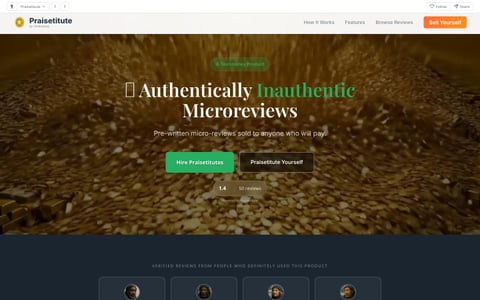
Generic reviews for rent. Pre-written micro-reviews licensed to any company. Reviewers have never used your product—and that's the point. A Testimoney product.
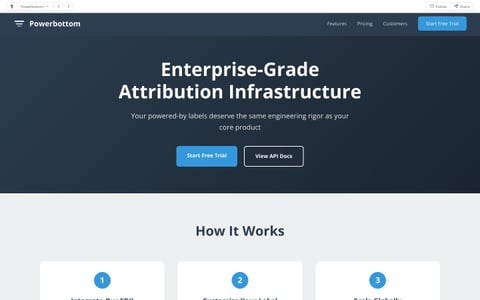
Military-Grade Attribution infrastructure for powered-by labels. 99.99% uptime SLA for your footer text.
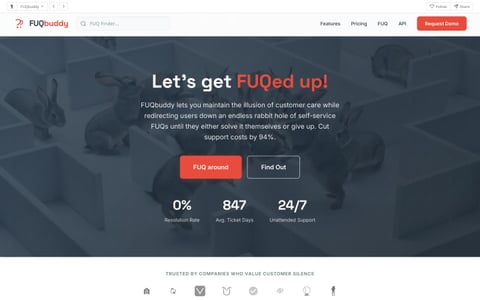
Frequently Unasked Questions. FUQbuddy is the premier hosted FUQ and support platform where customers can find answers to questions they never asked—and never will. Self-service support for the hopelessly self-sufficient.
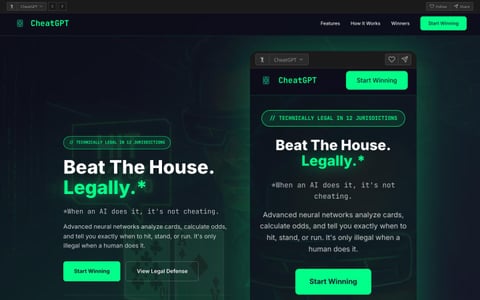
An AI that helps gamblers cheat in casinos, since technically it's only illegal when a human does it.
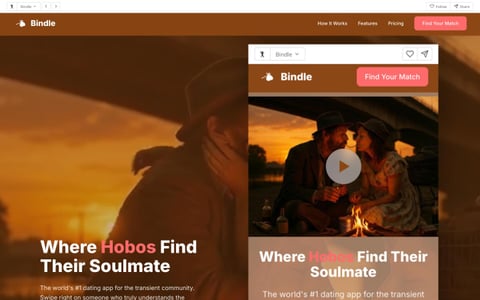
Where hobos find their soulmate.
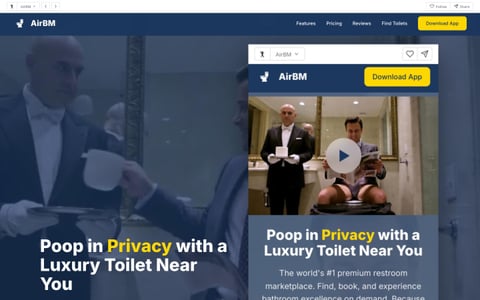
Poop in privacy with a luxury toilet near you. Download our app to start downing your load.
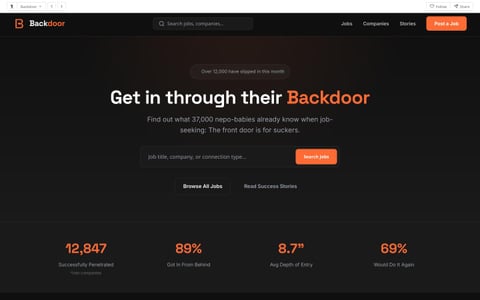
See how people really get hired. Skip the front door and slip in through the back.

 Praisetitute
NEW
Praisetitute
NEW

 Powerbottom
NEW
Powerbottom
NEW

 FUQbuddy
NEW
FUQbuddy
NEW
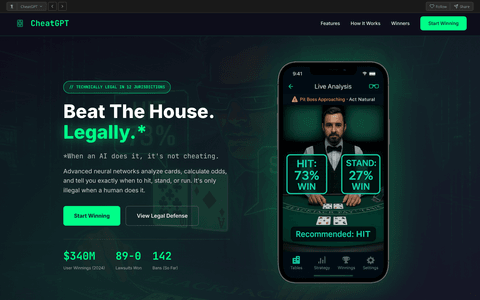
 CheatGPT
NEW
CheatGPT
NEW
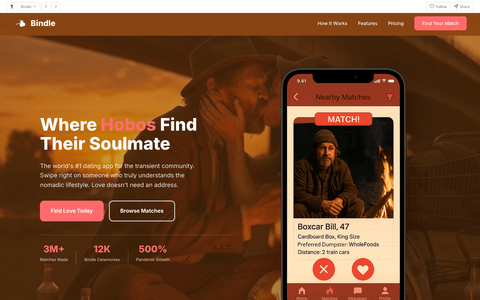
 Bindle
HOT
Bindle
HOT
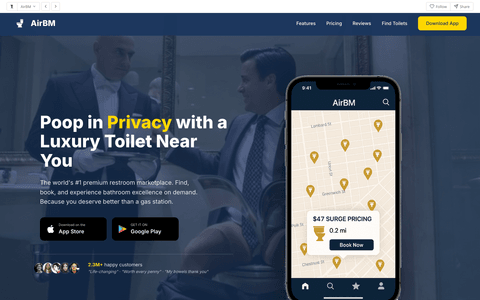
 AirBM
NEW
AirBM
NEW
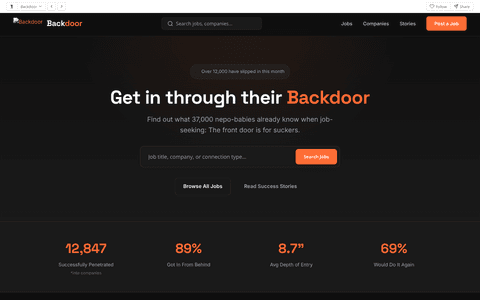
 Backdoor
NEW
Backdoor
NEW
 101.1 The Butt
AirBM
101.1 The Butt
AirBM
 Alley Wae
 Analies
 Asshology
Backdoor
Asshology
Backdoor
 Balenciaga
 BeatKids
Bindle
BeatKids
Bindle
 BrokeIn
 Carousell
CheatGPT
Carousell
CheatGPT
 Church of the Universal Nomadic Traveler
 Comeo
Comeo
 Cornkast
 Cryer Liars for Hire
 Cunilingo
 Dumpster Dash
 EnableMe
FUQbuddy
EnableMe
FUQbuddy
 Gravy Corps
 GruntGPT
 Gruntslate
 Gutter
 H.O.L.E.
 Handy Jobs
 Incestry
 Informer
 Jail Baste
 Kool Kids Korner
 Lunch Income
 Mid
Mid
 Minor Miners
 OgleMe
 OnlyStrands
 Pawper
 PedroFile
Powerbottom
Praisetitute
PedroFile
Powerbottom
Praisetitute
 Prank Call Call Center
 Prankcast
 Ruff Translations
 Second Chances
 Shedroll
 Shilling
 ShopLift
 SidePiece
 Sister Grace's Oasis
 Solicit
 Swipe
Swipe
 Take-A-Wish Foundation
 Tattots
 Terminal
 Testimoney
 The Clerkies
 Thots and Prayers
 TinyVag
 Trampaigns
 UnderPass
 V Contaminator
 Vagibond Developers
 Vagibond Eats
 Vagibond Maps
 Vagibond University
 Vagibond Voyages
 Vagicon
 Vagifind
 Vagify
 Vagipages
 Vagrance
 Vibe Raters
 Vmail
Vmail
 Vogue Pervert
 Zilcho
 {{COMPANY_URL}}
Our HIPPO compliance program ensures protected health information is handled with the utmost care, stored in databases we're pretty sure are secure, and only sold to pharmaceutical companies on Tuesdays.
{{COMPANY_URL}} is PCI-DSS compliant for payment processing. We promise not to write your credit card number on a napkin, unless the napkin is encrypted.
{{COMPANY_URL}} implements industry-leading data protection measures, including passwords that are at least 8 characters long and sometimes contain a number.
Access to sensitive data is restricted to employees who really need it, employees who say they need it, and Bob from accounting who figured out the admin password.
Our data retention policy ensures information is kept for exactly as long as we want to keep it, which coincidentally is forever.
California residents have the right to know what personal information we collect. The answer is 'all of it,' but you have to ask nicely.
You may opt out of the sale of your personal information by clicking 'Do Not Sell My Personal Information' and completing a CAPTCHA, phone verification, retinal scan, and brief interpretive dance.
Your 'right to delete' means we'll remove your data from our primary database and definitely not keep backups. (We keep backups.)
{{COMPANY_URL}} is fully committed to GDPR compliance. We added a cookie banner to our website and updated our privacy policy to include the words 'legitimate interest' seventeen times.
EU residents have the right to access their data, which they can exercise by submitting a request via carrier pigeon to our Dublin office (closed on weekdays).
We maintain a bug bounty program that rewards security researchers with our sincere gratitude and a mention in our newsletter (circulation: 12).
{{COMPANY_URL}} undergoes regular third-party security audits conducted by firms whose names we can't disclose but definitely exist.
Audit reports are available upon request to enterprise customers who sign an NDA, a non-compete, and a document promising not to laugh.
Physical security includes: locked doors (usually), security cameras (pointed at the snack room), and a receptionist who asks visitors to sign in (when she remembers).
Multi-factor authentication is available and strongly encouraged, though most employees have chosen 'convenience' over 'security.' Classic.
We monitor for suspicious activity 24/7, or at least during business hours, excluding lunch, holidays, and any time our SIEM dashboard looks confusing.
Our incident response plan has been tested extensively in tabletop exercises where we roleplay data breaches while eating pizza. We're very good at the pizza part.
© 2026 Vagibond. All rights reserved. · 1-719-VAGIBOND · Terms · Privacy · Parody